Home Manaslu & Tsum Manaslu Circuit Trek
The Manaslu Circuit trek is just as varied as the Annapurna Circuit. However, the great advantage of hiking around Manaslu is that you can traverse a tranquil region. Here, the Buddhist culture has kept its original character.
You’ll start and finish the trek in the tropical lower valleys. In between, you pass through wild gorges, raging waterfalls, and subtropical forests. Finally, you cross the Larkya La pass at an altitude of 5106 meters. The pass is located in a desolate landscape of rocks, snow, and ice. After crossing this high mountain pass, you will descend back into warmer climates.
The Manaslu Circuit trek itinerary begins with a scenic drive to Machha Khola. The last kilometers you travel on an unpaved road through the rice fields. First, you will hike through local villages and open wide trails. Here, it is warm and tropical, and you will pass through several bamboo forests.
The closer you get to the swirling Budhi Gandaki, the more you walk into a gorge. Once you arrive in the canyon, you will hike past high rock walls and beautiful waterfalls. Regularly, you cross the Budhi Gandaki River by suspension bridges. Additionally, you will hike right beside the roaring river.
Eventually, you hike out of the gorge, and the valley opens up to you. From here onward, Buddhist culture is visible throughout the landscape. This becomes evident when you pass by the typical Buddhist mani walls and chortens.
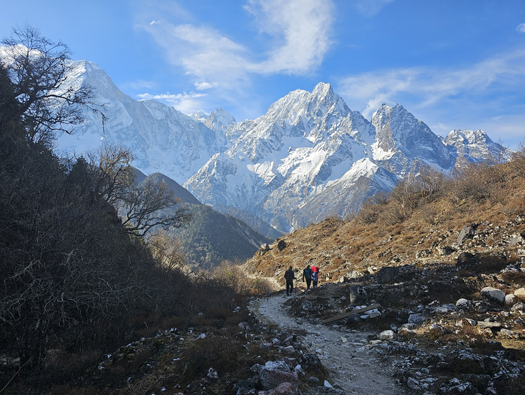
As you progress, more snowy peaks emerge to form a stunning backdrop. For acclimatization, you take a side trip to Pung Gyen Gompa. The monastery sits in the shadow of Manaslu Mountain. Starting from the village of Samagoan, the mountain slopes are overgrown with birch and juniper. From here on, it is still a couple of days of hiking to the Larkya La pass. At dawn, you will climb from Larkya Phedi to the high Larkya La pass. While crossing the pass, you will be treated to a spectacular view of the snowy mountain peaks. Among them are the famous Himalaya peaks, including Himlung Himal and Annapurna II.
After passing the Larkya La, the trail descends steeply downwards. Gradually, the alpine vegetation gives way to rhododendron forests as you descend. Your Manaslu Circuit Trek comes to an end in Tilje. From this final village, you’ll travel back to Kathmandu.
Our itineraries are designed to be flexible. If you would like to modify this plan, let us know, and we will work with you to create a personalized trip.
Day 1: Arrival Nepal; pick up at the international airport and drop off at a hotel in Thamel Kathmandu
Day 2: Free day at leisure in Kathmandu and finalizing the Manaslu Restricted Area Permit
Day 3: Drive from Kathmandu to Machha Khola (930 m – 8 hrs)
Day 4: Trek to Jagat (1340 m – 7 hrs.)
Day 5: Trek to Deng (1800 m – 6 hrs.)
Day 6: Trek to Namrung (2600 m – 8 hrs.)
Day 7: Trek to Shyala (3500 m – 3 hrs.)
Day 8: Climb to Pung Gyen Gompa valley and trek to Samagoan (3530m - 6 hrs.)
Day 9: Trek to Samdo (3860m - 5 hrs.)
Day 10: Acclimatization day in Samdo.
Day 11: Trek to Larkya Phedi (4460 m – 4 hrs.)
Day 12: Cross over Larkya La pass (5106 m) to Bimthang (3720 m – 8 hrs.)
Day 13: Trek to Tilje (2300m – 7 hrs.)
Day 14: Drive back to Kathmandu (8 hrs.)
Day 15: Free day at leisure in Kathmandu
Day 16: Departure; pick up from the hotel and drop off at the international airport
During the trekking season, prices may rise. The final price depends on the trekking season, group size, and the cost of local transfers.
Cost includes:
– Pick up and drop off from Kathmandu International Airport to hotel
– 4 nights in a hotel room in Kathmandu; breakfast included
– Teahouse room during trek
– Private drive from Kathmandu to Machha Khola; local drive from Tilje to Besisahar and onwards a private drive to Kathmandu
– Licensed and certified mountain guide. Well experienced and English speaking
– Porter service for carrying luggage; 10 kg per person
– Salary, food, accommodation and insurance for the mountain guide and porters
– 3 meals per day; breakfast/ lunch/ dinner
– Free use of a waterproof bag for your luggage
– Manaslu Restricted Area Permit (RAP), Manaslu Concervation Area Permit (MCAP), ACAP fee, TIMS card and local taxes
– Support of the Sherpa Heritage Trails head office in Kathmandu
Cost excludes:
– International flight to Kathmandu
– Nepal entrance visa
– Lunches and dinners in Kathmandu
– All beverage bills, hot shower, internet services, laundry and battery charge during trek
– Personal travel insurance
– Rescue operation charge in case of an emergency
– Any cost that arises due to a change of itinerary, like flight delay, natural calamities, etc.
– Gratitude and tips for the mountain guide and porters
Few treks in Nepal offer what Manaslu does. The trail stays remote, the villages feel untouched, and the Tibetan culture runs deep. You pass monasteries, mani walls, and high peaks that most trekkers never see.
Unlike Everest and Annapurna, Manaslu draws far smaller crowds and keeps its own pace. A special permit limits who can enter, which keeps the trail quiet and the experience genuine.
The Manaslu Circuit Trek offers a quieter and less crowded experience. The region has a strong Tibetan influence and traditional mountain villages. Compared to Everest or Annapurna, it feels far less commercial.
The Manaslu Circuit Trek is considered strenuous. Daily walks often last 6 to 8 hours. In addition, the crossing of Larkya La (5,106 m) requires a long ascent and descent. Because the trail is remote and less developed, it can feel more demanding than Annapurna.
Altitude is the biggest factor. Above 3,500 meters, the body needs time to adjust. The itinerary includes a rest day in Samdo for this reason. Trekkers who have walked multi-day routes before will find the daily distances manageable. Those with no hiking background should prepare well before attempting this route.
| Feature | Manaslu Circuit | Annapurna Circuit |
| Crowds | Less crowded | Busier |
| Remoteness | More remote | More developed |
| Permit | A restricted area permit is required | Standard permit |
| Highest Pass | Larkya La (5,106 m) | Thorong La (5,416 m) |
| Cultural Influence | Strong Tibetan influence | Mixed Hindu and Buddhist |
Overall, the Manaslu Circuit Trek is quieter and more remote than the Annapurna Circuit. It suits trekkers who prefer fewer crowds and a more traditional mountain route in Nepal.
Most Manaslu Circuit itineraries take 14 to 16 days. However, the exact length depends on the starting point and the number of rest days. In addition, some trekkers add a side trip to Pung Gyen Gompa or combine the route with the Tsum Valley.
The best months are March to May and September to November. During these seasons, the weather is usually stable and mountain views are clear.
However, snow can affect Larkya La early in the season. During the monsoon months, heavy rain increases landslide risk on the lower sections of the trail.
Yes, the Manaslu Circuit is harder than the Annapurna Circuit. The trails are rougher and less maintained. There are fewer villages along the way, so rest stops are more spread out.
The climb to Larkya La is long but gradual. The descent, however, has steep sections that can be tricky with snow and ice. For this reason, Sherpa Heritage Trails always has microspikes available at the pass.
The remote setting also means help is further away if something goes wrong. That said, fit trekkers with prior hill walking experience handle it well.
Larkya La, also known as Larke La, sits at 5,106 meters. It is the highest point of the Manaslu Circuit. At that height, the air is thin and the cold can be sharp, even in peak season.
Most groups set off before dawn. The goal is to cross early and reach Bimthang before the afternoon. From the top, the views stretch across Himlung Himal, Cheo Himal, and Annapurna II. It is a tough day, but one of the best on the trek.
Yes, the Manaslu Circuit remains one of the quieter treks in Nepal. Permit rules limit the number of visitors, and the trail is more remote than Everest or Annapurna.
On many sections, you will pass only a handful of other trekkers in a full day of walking. Large groups are rare. That sense of space is hard to find on the more popular routes in Nepal.
The trek usually starts in Machha Khola, a small village about a day’s drive from Kathmandu. From there, the trail follows the Budhi Gandaki River through remote valleys and mountain villages. Over the next days, trekkers gradually gain altitude before crossing Larkya La Pass at 5,106 meters.
Some older itineraries start lower in the valley at Soti Khola. Today many treks begin in Machha Khola to shorten the road section.
The Manaslu region is a restricted area near the Tibetan border. For this reason, trekkers must obtain a Manaslu Restricted Area Permit. In addition, permits for the Manaslu and Annapurna conservation areas are required. These rules help protect the culture and environment of the region.
Yes, you can. As of March 22, 2026, the permit rules changed. You no longer need a second trekker to get a Manaslu permit. Solo person permits are now available. Permits must still be arranged through a registered trekking company. We take care of this before you leave Kathmandu. Because Manaslu is a restricted area, a licensed guide is still mandatory.
It is possible for beginners, but this is not an easy trek. The days are long and the terrain is rough in places. Prior hiking experience helps a lot.
If you are new to trekking, build up your fitness before you go. Training on hilly terrain for at least two months makes a real difference. A good guide will also help you manage the pace and spot early signs of altitude sickness.
Yes, the most popular addition is the Tsum Valley Trek. This takes you into a hidden valley north of the main circuit. It adds roughly 7 to 10 days and passes through some of the most untouched villages in Nepal. Some trekkers also connect to the Annapurna Circuit via Dharapani route. Both options suit those who want a longer trip with more variety.
All nights are spent in local teahouses. Rooms are basic with a bed, blankets, and a shared bathroom. Lower on the trail, some lodges offer private rooms with attached bathrooms. Higher up, expect shared facilities and thinner walls.
Hot showers are available at some stops, though not all, and a small fee usually applies. Each teahouse has a dining hall where meals are served. After sunset or on cold days, the dining hall is typically heated, making it a warm place to rest and eat after a long day.
Teahouses along the route serve a mix of Nepali and basic Western food. Portions are generous and meals are filling after long days on the trail.
A typical menu includes:
At lower altitudes, menus are wider. Higher up, options narrow and prices rise slightly. Dal Bhat remains the best value meal on the trail and is available everywhere.
We encourage all trekkers to carry a reusable bottle and a water filter. Clean water sources are available along the route. Using a filter is better for your budget and cuts down on plastic waste in the mountains. Sherpa Heritage Trails provides guidance on safe water points during the trek.
Signal is weak for most of the route. Ncell tends to work better than NTC in some areas, but neither is reliable. A few teahouses offer Wi-Fi for a small fee. Speeds are slow, so video calls are rarely possible.
It is best to let family know in advance that contact will be limited. Most trekkers find this a welcome break from their phones.
Yes, most teahouses have power sockets. Charging is often available in common rooms or sometimes in your room. A small fee may apply at higher altitudes where power comes from solar panels. Bring a power bank as a backup. On long days between villages, there may be no chance to charge until you reach the next lodge.