Home Everest & Rolwalling Everest Three Passes
The Everest Three Passes Trek is one of Nepal’s great high routes. It links three remote passes, Everest Base Camp, and the Gokyo Lakes, all in one 18-day trek. Unlike the main trail to Everest Base Camp, this route stays quiet. As a result, you move through remote valleys with far fewer trekkers around you.
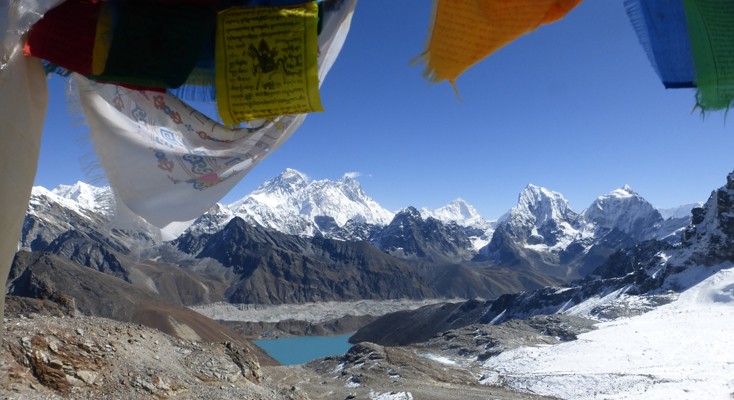
Along the way, you cross the Renjo La, Cho La, and Kongma La passes. None of them are on the standard Everest trail, so the paths stay peaceful and uncrowded. If you want to go further, three peaks are there to climb as well. Gokyo Ri (5,357 m), Kala Patthar (5,554 m), and Chukung Ri (5,550 m) all reward the effort with stunning views. From every high point, Everest and the full Khumbu range stretch out before you.
The Everest Three Passes journey begins with the flight from Kathmandu to Lukla. From Lukla Airport, it is a short walk to Phakding, a good first step into the mountains. From here on, you hike towards Namche Bazaar, the Sherpa capital. In Namche, you will take a resting day for further acclimatizing. An optional day hike is possible to the Everest View hotel.
You leave Namche Bazaar and head into the remote Nangpa Valley towards Thame. The tough climb towards the Renjo La pass is long and steep, but very rewarding. The views stretch across Everest, Cho Oyu, and dozens of lesser-known peaks. The descent to the idyllic Gokyo Lakes is quite leisurely. At the Gokyo Lakes, you can enjoy a resting day or climb to the high peak of Gokyo Ri (5483 meters) for another stunning view of the mountains.
After Gokyo, you continue the trek over a glacier and climb towards the Cho La Pass. Crossing this pass, you will enter the main trail to Everest Base Camp. From Gorakshep, you will make a day hike to the base camp on the Khumbu Glacier. Still enjoying this highlight, you will immediately be treated to another one.
It is an easy climb to Kala Patthar peak. From this viewpoint, the Khumbu mountains are very close. You can almost touch Pumori Mountain. After this viewpoint, you descend to Lobuche before heading over the Kongma La pass to Chhukung. This pass is the last of the Everest Three Passes.
Here you can optionally climb another peak, Chukung Ri (5560 meters). This is a pleasant hill above the teahouse with views of the Ama Dablam, Lhotse, Makalu, and Cho Oyu. From Chhukung, you will return to Lukla, passing beautiful Sherpa villages and the impressive Tengboche monastery. A flight back to Kathmandu ends this Everest Three Passes adventure.
Our itineraries are designed to be flexible. If you would like to modify this plan, let us know, and we will work with you to create a personalized trip.
Day 1: Arrival Nepal; pick up at the international airport and drop off at a hotel in Thamel Kathmandu
Day 2: Free day at leisure in Kathmandu
Day 3: Flight Kathmandu/ Ramechap to Lukla (0,5 hrs.) and trek to Phakding (2640 m – 3 hrs.)
Day 4: Trek to Namche Bazaar (3440 m – 5 hrs.)
Day 5: Resting day at Namche Bazaar for acclimatization. Optional day hike to the Everest View hotel
Day 6: Trek to Thame (4200 m – 4 hrs.)
Day 7: Trek to Lungdhen (4380 m – 6 hrs.)
Day 8: Acclimatization day hike
Day 9: Cross over Renjo La pass (5360 m) to the Gokyo Lakes (4800 m –9 hrs.)
Day 10: Resting day or optional climb to Gokyo Ri (5357 m)
Day 11: Trek to Thangnang (4750 m – 3 hrs.)
Day 12: Cross over Cho La pass (5367 m) and descend to Lobuche (4930 m – 7 hrs.)
Day 13: Trek to Gorakshep (5170 m – 5 hrs.)
Day 14: Visit Everest Base Camp (5364 m), overnight in Gorakshep (5170 m – 6 hrs.)
Day 15: Trek to Kala Patthar (5554 m) and overnight in Lobuche ( 4930 m – 6 hrs.)
Day 16: Cross over Kongma La pass (5535 m) to Chhukung (4720 m – 7 hrs.)
Day 17: Climb Chhukung Ri (5550 m) and trek to Dingboche (4290 m – 6 hrs.)
Day 18: Trek to Namche Bazaar via Tengboche Monastery (3440 m – 6 hrs.)
Day 19: Trek to Lukla (2800 m – 5 hrs.)
Day 20: Flight Lukla to Kathmandu / Ramechap (flight 0,5 hr.)
Day 21: Free day at leisure in Kathmandu
Day 22: Departure; pick up from the hotel and drop off at the international airport
During the trekking season, prices may rise. The final price depends on the trekking season, group size and, if applicable, the cost of the local transfers.
Cost includes:
– Pick up and drop off from Kathmandu International Airport to the hotel
– 4 nights hotel room in Kathmandu; breakfast included
– Teahouse room during trek
– Return flight Kathmandu/ Ramechap to Lukla and transfer to and from the domestic airport
– Licensed and certified mountain guide. Well experienced and English speaking
– Porter service for carrying luggage; 10 kg per person
– Salary, food, accommodation and insurance for the mountain guide and porters
– 3 meals per day; breakfast/ lunch/dinner
– Free use of a waterproof bag
– Sagarmatha National Park entrance fee, TIMS card and local taxes
– Support of the Sherpa Heritage Trails head office in Kathmandu
Cost excludes:
– International flight to Kathmandu
– Nepal entrance visa
– Lunches and dinners in Kathmandu
– All beverage bills, hot shower, internet services, laundry and battery charge during trek
– Personal travel insurance
– Rescue operation charge in case of an emergency
– Any cost that arises due to a change of itinerary, like flight delay, natural calamities, etc.
– Gratitude and tips for the guide and porters
The Everest Three Passes Trek is a high-altitude circuit in the Khumbu region of Nepal. It crosses three mountain passes: Renjo La, Cho La, and Kongma La.
Along the way, the route also takes in Everest Base Camp and the Gokyo Lakes. At 18 days of trekking, it is longer and more demanding than the standard Everest Base Camp trek. Even so, it rewards with remote trails, wide views, and far fewer crowds.
Yes, for the right trekker, it is one of the best routes in Nepal. In a single trip, you cross three remote passes and reach Everest Base Camp. Along the way, you look down over the Gokyo Lakes, and walk trails where you may not pass another group all day.
The standard Everest Base Camp trek follows one valley there and back. This route is a full circuit, so every day brings somewhere new. The effort is real, but so is the reward.
This is one of the hardest routes in the Khumbu. Daily walks run 6 to 9 hours. All three passes sit above 5,300 meters. Cho La and Kongma La can be icy, with steep, rocky terrain. So, good footwear and trekking poles really matter.
On top of that, you spend several days above 5,000 meters. At that height, thin air slows the body and affects sleep. Prior high-altitude trekking experience helps a lot. If this is your first time in the Himalaya, the standard Everest Base Camp trek is a better start.
Both routes explore the Everest region, but they differ in difficulty, route structure, and overall experience.
| Feature | Everest Three Passes Trek | Everest Base Camp Trek |
| Difficulty | Strenuous | Moderate |
| Duration | 20–22 days | 12–14 days |
| Highest Point | 5,535 m (Kongma La) | 5,545 m (Kala Patthar) |
| Route Type | Loop route | Out-and-back route |
| Crowds | Less crowded | Busier in peak season |
| Scenery | Passes, glaciers, and lakes | Valley views and base camp |
| Experience Level | Best for trekkers with prior high-altitude experience | Suitable for fit and first-time trekkers |
Everest Three Passes is better suited to experienced trekkers seeking a more demanding, varied route. The Everest Base Camp Trek offers a shorter and more direct journey to the base of the world’s highest mountain.
Most trekkers need around 18 days to complete the route. That said, the exact length depends on a few things. Your pace matters, and so do the rest days you take for acclimatization. Side trips also add time. Climbing Gokyo Ri, for example, takes an extra day.
Some trekkers move faster and finish in 16 days. Others prefer a slower pace to enjoy the journey. We always recommend not rushing at altitude.
Spring and autumn are the best seasons. March to May brings stable weather and clear skies. The mountain views are sharp, and the trails are in good shape. September to November is equally good, often with very settled conditions in October.
In winter, snow closes the passes and makes crossing them much harder. During the monsoon, heavy rain reduces views and makes paths slippery. So plan around those two windows if you can.
Each pass brings its own challenge. Renjo La, at 5,344 meters, is the easiest of the three. The climb is long, but the ground is mostly solid, and the descent to the Gokyo Lakes is pleasant. Cho La, at 5,367 meters, is tougher. The upper section can be icy, especially near the glacier, so microspikes are worth having.
Finally, Kongma La, at 5,535 meters, is the hardest crossing. The ascent is steep, and the ground is rough, with rocky sections and glacier moraine to navigate. That said, all three passes are non-technical. With the right preparation and a good guide, they are well within reach.
The highest point on the trek is Kala Patthar, at 5,554 meters. It is reached on day 15, after visiting Everest Base Camp. From the top, the views of Everest and the Khumbu icefall are hard to match. Kongma La pass, at 5,535 meters, is the highest of the three passes. Both days are among the most demanding on the route, so good acclimatization beforehand really pays off.
Yes, a visit to Everest Base Camp is part of the standard route. You reach it on day 14, after crossing the Cho La pass. The base camp sits on the edge of the Khumbu Glacier at 5,364 meters. It is a powerful place to stand, even without climbing. From there, you head to Gorakshep for the night. The next morning brings the climb to Kala Patthar for sunrise views of Everest.
Experienced trekkers can follow the route without a guide. However, the Three Passes is not a straightforward trail. Route finding on the passes can be tricky, especially in poor weather or snow. A guide also helps with acclimatization decisions and knows when to push on or rest.
Beyond safety, a local guide adds real depth to the experience. They know the villages, the people, and the mountains in a way no map can replace.
Two permits are needed for the trek. The first is the Sagarmatha National Park entry permit. The second is the Khumbu Pasang Lhamu Rural Municipality permit. Both are arranged during the trek and checked at the first entry point. When you book with Sherpa Heritage Trails, we take care of all of this for you during the trek.
Yes, and it is something to take seriously. The route crosses three passes above 5,300 meters. You also spend several nights above 4,900 meters. That is why the plan includes rest days in Namche Bazaar and Lungdhen.
Go slowly, drink plenty of water, and watch for the signs. Headache, nausea, and poor sleep are the main ones. If symptoms get worse, going down is always the right call. Our guides know the early warning signs and act fast.
During the trek, accommodation is in local teahouses. Rooms are simple, with twin beds and shared toilets. Most also have a shared dining room. In Namche Bazaar, lodges are more comfortable and better equipped. Higher up, at stops like Gorakshep or Lobuche, rooms are basic and nights get cold. Hot showers are available at most stops for a small fee.
Teahouses serve a good mix of local and simple Western dishes. Dal bhat is the staple and available everywhere. You will also find noodle soup, fried rice, momos, eggs, and pancakes. In larger villages like Namche Bazaar, menus are wider. Some places offer pasta, pizza, and fresh bread.
Higher up, the choice narrows, and prices rise a little. Even so, portions are generous, and meals are hot after a long day on the trail.
No technical climbing gear is needed. However, the right clothing and kit make a real difference. Bring warm layers, a good down jacket, and sturdy waterproof boots. A sleeping bag rated to minus 15 degrees is worth having, even though teahouses provide blankets.
If the passes are icy, microspikes give useful grip on the steeper sections. Trekking poles also help, especially on the long descents. If you are missing any gear, we can help with rentals before you set off.
If you book with Sherpa Heritage Trails, you can rent a sleeping bag, a down jacket, and microspikes directly from us. We check all rental gear before each trip, so it is reliable and well-maintained.
For anything else you need, we can point you to trusted gear shops in Kathmandu. The Thamel area has a wide range of shops where you can buy whatever you need. We always suggest sorting gear in Kathmandu rather than on the trail.
Bottled water is available along the route, but it gets expensive at higher stops. It also creates a lot of plastic waste in a fragile mountain environment. For both reasons, we recommend a refillable bottle and a water filter.
Clean water sources are easy to find along the way. A filter keeps things simple and cheap. It is a small change that makes a real difference up in the mountains.
The signal is limited for most of the route. Some teahouses offer their own Wi-Fi connection. Other teahouses sell Everest Link cards for Wi-Fi access in the region. However, speeds are slow, and the connection is not always reliable. Above 4,000 meters, it gets weaker still.
Mobile coverage from NTC or Ncell is available in many villages. On the high passes, though, expect nothing. Most trekkers find the disconnect a welcome break. Still, let family know in advance that contact will be limited.
Most teahouses have power sockets in the dining room. Higher up, power comes from solar panels, and a small fee may apply. On long days between stops, there may be no chance to charge at all. So bring a power bank as a backup. Also, keep in mind that cold drains batteries fast. At high camps, keep your devices inside your sleeping bag overnight.


