Home Buddhist Festivals Mani Rimdu at Chiwong Monastery
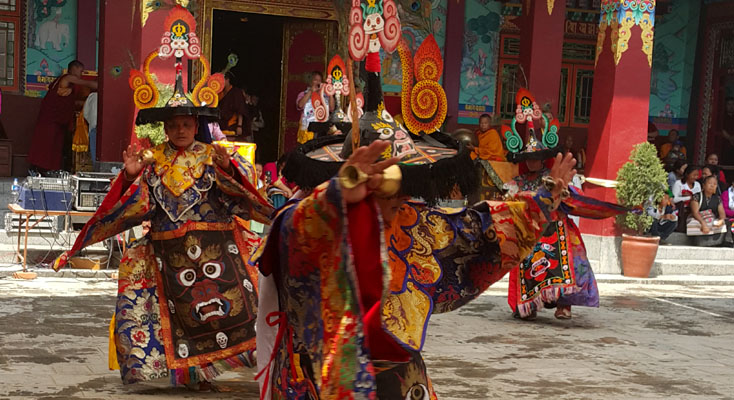
We travel by jeep to the heart of the Lower Everest region. Here, nearby Phaplu is the Chiwong monastery, also known as Chiwang. This cultural tour is focused on joining and attending the Mani Rimdu festival.
To join the festival at Chiwong Monastery is a rare opportunity to submerge in the local Sherpa culture. The Public Days festival is a three-day festival that is being held at Tengboche Monastery and Chiwong Monastery. The date of the festival varies each year as it depends on the Buddhist lunar calendar.
Mani Rimdu takes place from the first day of the tenth month of the Tibetan lunar calendar, falling between mid-October and mid-November. It lasts until the nineteenth day of the month. From the beginning until the end of the festival, 24-hour Puja (rituals) will be performed by the monks to consecrate the Mandala, the Mani Rilwu (sacred pills), the Tshereel (pills for long life), and the Torma.
The Sand Mandala
The sand mandala is carefully constructed, grain by grain, from coloured sand. It is an intricate and symbolic design that takes many days to complete. Protective dagger deities are placed around the mandala, and the bowl of Mani Rilwu pills (spiritual medicine) is placed above the centre.
The Rilwu Pills
Rinpoche calls this “liberation by eating”. The Rilwu are distributed to everyone after he gives long life empowerment to the people who come.
The Torma
The torma is made from barley flour and decorated with coloured butter. It begins by symbolising the body of the deity, and by the end of the ceremony, symbolises enlightenment itself. It stands in front of the mandala on its shrine, at the very heart of the temple.
Our itineraries are designed to be flexible. If you would like to modify this plan, let us know, and we will work with you to create a personalized trip.
Day 1: Arrival Nepal; pick up at the international airport and drop off at a hotel in Thamel Kathmandu
Day 2: Drive from Kathmandu to Phaplu or Chiwong Khop (2590m – 9 hrs.)
Day 3: Trek/ drive to Chiwong Monastery (2715m – 2 hrs.); start of Mani Rimdu. The Empowerment (Wong) The Wong is the opening day of the public ceremony. It’s performed on the full moon day, the tenth month in the Tibetan lunar calendar. The sacred Mani Rilwu (sacred pills) and Tshereel (pills for long life) are given to everyone attending.
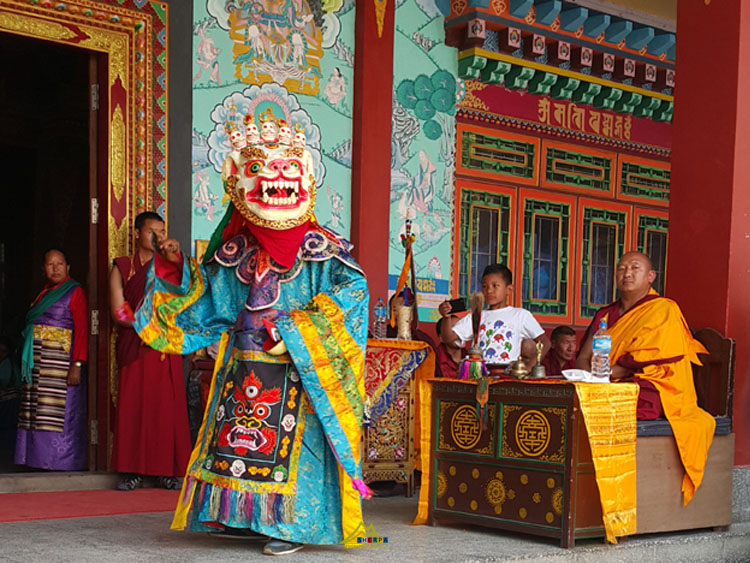
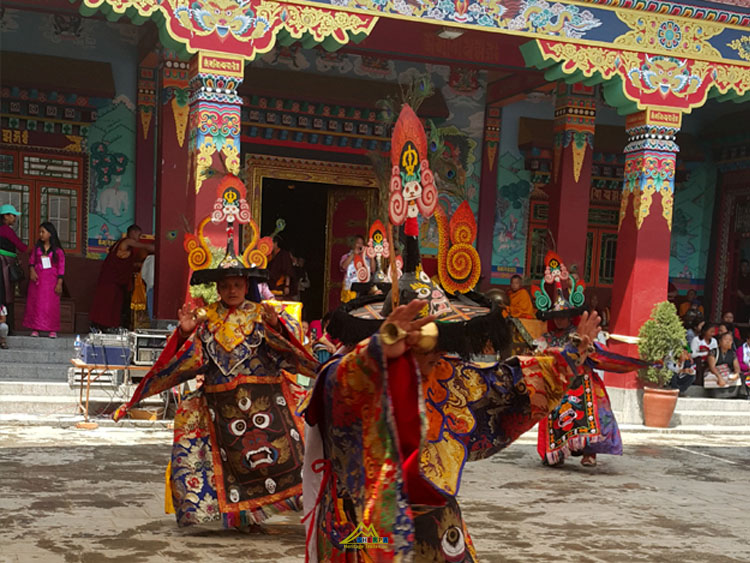
Day 4: Trek/ drive to Chiwong Monastery (2 hrs.); second day of Mani Rimdu. The Dances (Chham) The dances take place on the 2nd public day of Mani Rimdu. Symbolic demons are conquered, chased away, or transformed into Protectors of Dharma. As the theme of the dance positive forces fight with those of disorder through the dances. The dances convey Buddhist teaching on many levels from the simplest to the most philosophical. During the dance, the monks are believed to become divine beings. The dances are only performed during Mani Rimdu because they are considered very Sacred, and not for ordinary entertainment.
Day 5: Trek/ drive to Chiwong Monastery (2 hrs.); third day of Mani Rimdu. The Fire Puja (Jinsak) The Fire Puja is performed in the yard. The Fire Puja is an offering to Agni (the god of fire), and the Gods of the mandala – to allay all harm in the world. The harm is visualized as dissolving into the grain and butter is burned.
Day 6: Trek/ drive to Chiwong Monastery (2 hrs.); foruth day of Mani Rimdu. The Naga Mandala ( The Naga) The Naga is a mythical serpentine creature appearing as a human or snake, or both together with a human torso above and a coiled snake’s tail below. They inhabit the regions beneath the and the oceans. The Naga sand mandala in the temple is ritually pulled to pieces, and the sand is given as an offering to the serpent gods.
Day 7: Day hike to Ratnangge for the viewpoint of Solukhumbu; or visit the local village of Salleri.
Day 8: Drive from Phaplu to Kathmandu (8 hrs.)
Day 9: Free day at leisure in Kathmandu
Day 10: Departure; pick up from the hotel and drop off at the international airport
During the trekking season prices may rise. The final price depends on the trekking season, group size and the cost of local transfers.
Cost includes:
– Pick up and drop off from Kathmandu International Airport to the hotel
– 3 nights hotel room in Kathmandu; breakfast included
– Teahouse room in Chiwong Khop or Phaplu during the tour
– Return drive from Kathmandu to the start and from the end of the tour
– Licensed and certified mountain guide. Well experienced and English speaking
– Porter service for carrying luggage; 10 kg per person
– Salary, food, accommodation and insurance for the mountain guide and porters
– 3 meals per day; breakfast/ lunch/ dinner
– Free use of waterproof bag for your luggage
– TIMS card and local taxes
– Support of the Sherpa Heritage Trails head office in Kathmandu
Cost excludes:
– International flight to Kathmandu
– Nepal entrance visa
– Lunches and dinners in Kathmandu
– All beverage bills, hot shower, internet services, laundry and battery charge during trek
– Personal travel insurance
– Rescue operation charge in case of an emergency
– Any cost that arises due to a change of itinerary like flight delay, natural calamities, etc.
– Gratitude and tips for mountain guide and porters